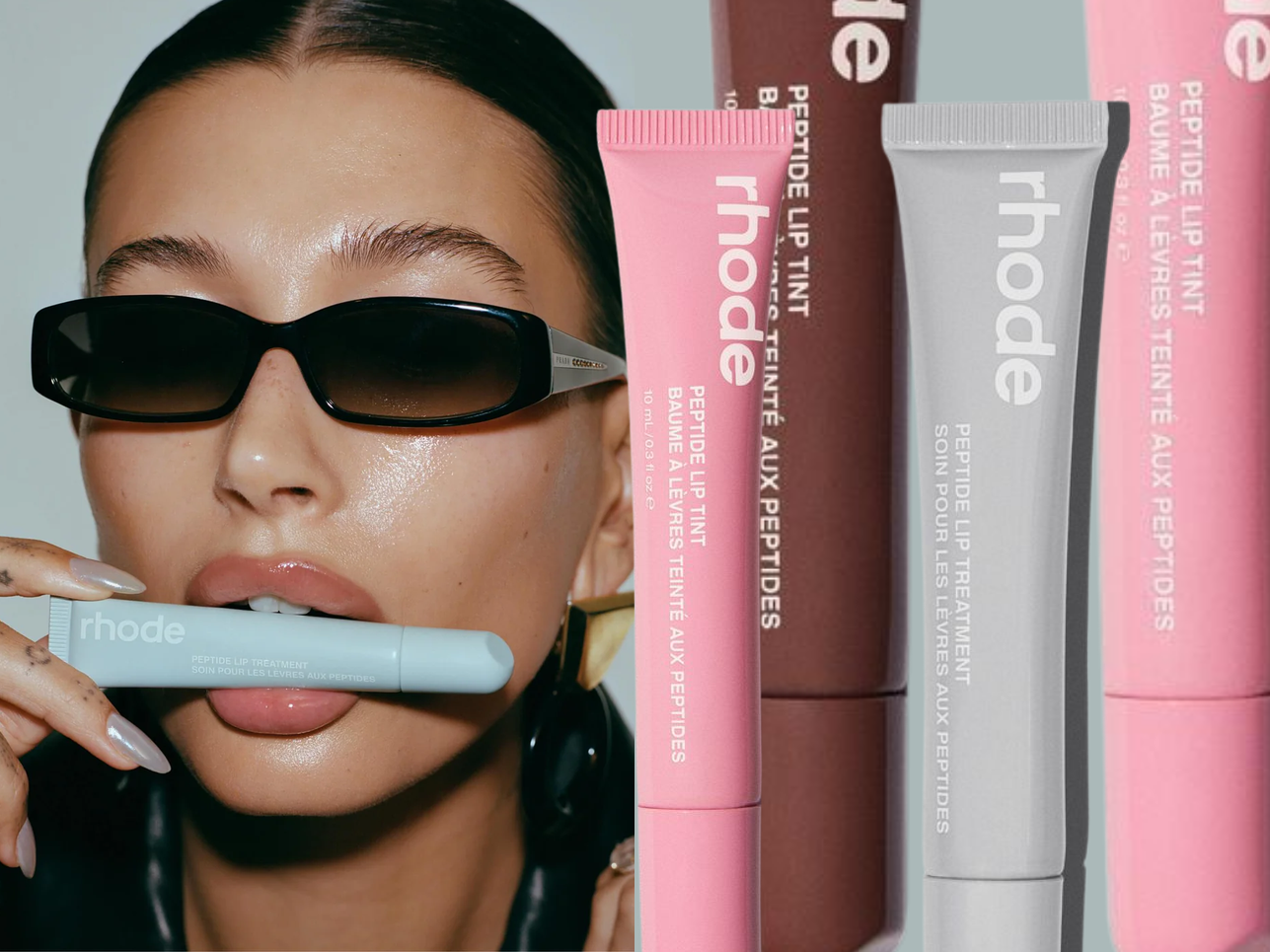
There is a very specific moment that happens when you start noticing the Rhode Peptide Lip Treatment. At first, you see one. Then another. Then suddenly it seems like every girl on your Instagram has one tucked into her handbag, every TikTok creator is applying it between sentences and every café table has a little Rhode tube sitting next to someone's iced coffee.
It is not just that people are using lip balm. People have been using lip balm forever. It is that everyone seems to be using the same one.
The little tube has become so recognisable that it almost functions like an accessory. You can see it in someone's hand before you know what they are wearing. It has its own visual language: the simple packaging, the glossy finish, the carefully chosen flavours and the tiny tube that looks almost too pretty to hide inside a makeup bag.
And the strangest part is that this is a product whose basic job is incredibly ordinary. It moisturises your lips. That's it.
So why this lip treatment? Why Rhode? Why did a product that costs around $20 become such a cultural phenomenon that its parent company was eventually valued at roughly $1 billion when e.l.f. Beauty agreed to acquire it?
The obvious answer is Hailey Bieber. But I think that explanation is too easy. Celebrity can get people to notice a product, but it cannot necessarily explain why they keep buying it, talking about it, photographing it and turning it into part of their identity.
And that brings us to a much more interesting question:
Are we buying Rhode because we love what it does to our lips — or because we love what carrying Rhode says about us?
Let's be fair to the product first
Before we dissect the marketing, we should acknowledge something important. Rhode did not invent a useless product and convince millions of women to pretend it works.
The Peptide Lip Treatment is a real formulation with ingredients designed to provide emollience, hydration and a glossy finish. Rhode's current formula contains ingredients including shea butter, vitamin E and palmitoyl tripeptide-1, a peptide the brand says helps hydrate, smooth and reduce the appearance of fine lines. The formula also contains a range of waxes and emollients that give it its thick, glossy texture.
Rhode says the treatment is intended to hydrate and replenish lips, and its current product page reports strong consumer-perception results for reducing the appearance of dry lips and improving softness.
So if you buy it and think, “My lips feel really good,” that is completely plausible. The product has a purpose, the formula has ingredients, and the texture, glossy finish, flavours and packaging are all deliberate.
The question isn't whether the product works. The question is: Why did this particular product become the one everyone wanted?
There are thousands of lip treatments, and most of them do not have people carrying them around like tiny status objects.
Lip balm was never supposed to be exciting
Think about the category Rhode entered. Lip balm is one of the least glamorous beauty products. Nobody historically built an entire identity around having a good lip balm. You bought one at the pharmacy, kept it in your handbag, lost it and bought another one. It was functional and almost invisible.
Rhode changed the emotional positioning. The Peptide Lip Treatment wasn't presented simply as something you use when your lips are dry. It became part of a beauty routine, then part of an aesthetic and eventually part of a lifestyle.
That shift is enormously important. Once a functional product becomes aesthetic, its value is no longer determined only by what it does. It is also determined by how it makes you feel when you use it.
Then Hailey Bieber entered the picture
Obviously, we cannot talk about Rhode without talking about Hailey Bieber. Rhode launched in 2022, and from the beginning the brand was closely associated with Bieber's personal image: minimal makeup, glossy skin, neutral colours, simple clothing, slick hair and the increasingly influential “clean” beauty aesthetic.
But Bieber did something particularly powerful. She didn't simply advertise products. She embodied the world the products belonged to.
This is a very different kind of celebrity marketing. Imagine an actress holding a lipstick in a traditional advertisement and saying, “I love this lipstick.” That's an endorsement.
Now imagine a celebrity whose entire beauty identity is built around a certain look, and the products they supposedly use become part of the formula for recreating that look. That's more powerful because you're not just buying the product. You're buying a small piece of the visual language surrounding the person.
Suddenly, the question changes from “Do I need a lip treatment?” to “Do I want to look like the kind of woman who carries this?”
The product became an accessory
This is probably one of Rhode's smartest achievements. The Peptide Lip Treatment doesn't look like a medical product or something you hide in the bottom of your bag. It is designed to be seen.
The packaging is minimal, the tube is small, the branding is restrained and it photographs well. Because it is something you apply repeatedly throughout the day, people naturally see it.
That matters enormously in the age of social media. A moisturiser sits in your bathroom, but a lip treatment comes with you. It goes to work, to university, to dinner, to a café and on holiday. It sits in your handbag and then in your hand. Therefore, it becomes part of your visible identity.
You are not only using the product. You are displaying it.
And then came the phone case
This is where the strategy becomes even more interesting. Rhode's phone case with a dedicated holder for the Peptide Lip Treatment effectively turned the product into part of the phone itself.
And that is genius. What is one of the most visible objects you carry all day? Your phone.
Instead of putting the lip treatment inside your handbag, the design makes the product visible alongside the phone. The lip product becomes an accessory to an accessory. Suddenly, something that used to be hidden becomes part of the outfit.
That is not accidental product design. It is a form of cultural positioning.
Rhode wasn't just selling something for your lips. It was creating a visual object that could travel through social media.
This is where TikTok changes everything
Traditional advertising interrupts culture. TikTok can make a product become culture.
Someone posts their morning routine and the Rhode lip treatment appears. Someone films what's in their handbag and Rhode appears. Someone makes a “clean girl makeup” tutorial and Rhode appears. Someone reviews the latest flavour and Rhode appears. Someone shows their new phone case and Rhode appears.
The product begins appearing so frequently that familiarity starts doing part of the marketing. You don't need someone to tell you, “This is popular.” You can see that it is popular.
And that creates a fascinating psychological effect: everyone else seems to have one. Which makes you wonder: Should I have one too?
Social proof is one of the most powerful forces in consumer behaviour
We tend to assume that our preferences are entirely personal. They're not. Humans constantly use other people's behaviour as information.
If a restaurant has a huge queue, we assume the food must be good. If thousands of people give a product five stars, we assume it must work. If everyone in a particular social group carries the same bag, we assume there is something desirable about it.
This is social proof.
Beauty is particularly vulnerable to it because beauty products are difficult to evaluate before you buy them. You cannot know exactly how a lip treatment will feel on your lips until you use it. So what do you do? You look at other people.
Rhode gave consumers an extraordinary amount of other people to look at: TikTok creators, beauty influencers, celebrities, friends, strangers and the algorithm. Eventually, the product begins to feel less like a recommendation and more like common knowledge.
Then the word “peptide” does some psychological work
Let's talk about the name: Peptide Lip Treatment.
That sounds more sophisticated than “lip balm.” Technically, it is not just a traditional waxy balm because the formula does contain a peptide. But notice what happens culturally when skincare language enters a product.
“Lip balm” sounds basic. “Peptide treatment” sounds scientific. Suddenly, your lip product has moved from the makeup aisle into the skincare conversation.
It sounds like you're not just making your lips glossy. You're treating them, improving them, supporting them and investing in them.
This is part of a broader trend across beauty. We increasingly want our makeup to sound like skincare, our skincare to sound like science and our wellness products to sound clinical. The more sophisticated the vocabulary becomes, the more sophisticated the product can feel.
That doesn't mean the claims are false. It means language contributes to perceived value. And Rhode understands that extremely well.
But here's something interesting about the actual formula
Look at the ingredients and the picture becomes less mysterious. The current formula contains a lot of familiar cosmetic ingredients: emollients, waxes, shea butter, vitamin E and oils and butters designed to create a nourishing, glossy texture, alongside the peptide.
That's not a criticism. It's how cosmetic formulation works. A product needs a base, texture and stability. It needs ingredients that make it spread, feel comfortable and stay on the lips.
The interesting part is that the word “peptide” can become much more prominent in our minds than the rest of the formulation.
We see PEPTIDE, and our brain fills in the rest: science, advanced skincare, anti-ageing, technology and results.
But the presence of a sophisticated-sounding ingredient does not automatically mean the product is dramatically more effective than every simpler lip balm on the market. That's something worth remembering whenever beauty marketing starts turning an ingredient into an identity.
Because the product doesn't actually need to be revolutionary
This is one of the biggest lessons from Rhode. A product doesn't have to invent a completely new category to become culturally enormous. It can take something people already use and make it more desirable.
Lip balm already existed. Gloss already existed. Lip oils already existed. Peptides already existed in skincare. Celebrity endorsements already existed. Minimal packaging already existed. Social media marketing already existed.
Rhode put them together in a particularly effective way. That is often what great consumer brands do. They don't necessarily invent a new human desire. They repackage an existing desire in a new cultural language.
The flavour names matter too
This might sound insignificant, but it isn't. Rhode's different Peptide Lip Treatment flavours turn the product into a collection: vanilla, salted caramel, strawberry and others.
Now you don't necessarily have a lip treatment. You can have favourites, collect them, choose one based on your mood, talk about them, compare them and wait for a new launch.
Suddenly, a functional product becomes a small hobby.
This is one of the easiest ways brands increase engagement. If one product solves the problem, you only need one. If the product becomes part of a collection, there is always a reason to buy another. The consumer relationship becomes much longer.
And then something even more interesting happens
You start recognising other Rhode users. You see someone pull the tube out of her bag, and you know what it is. She knows that you know what it is. There is a tiny moment of recognition.
That sounds ridiculous, but it is exactly how symbols work. A symbol creates shared knowledge.
A particular handbag, watch, café, book or skincare product can communicate something about the person carrying or using it. You recognise the object, and by recognising it, you recognise something about the person carrying it.
That is social signalling. Rhode has achieved something unusual for a relatively inexpensive beauty product: it became recognisable enough to function as a signal.
This is why the price is so interesting
At around $20, Rhode is not an ultra-luxury product. It's not a €1,700 Louis Vuitton bag, but it isn't an anonymous €2 lip balm either.
It occupies a very clever middle ground. It is affordable enough to feel attainable, expensive enough to feel special, prestigious enough to feel desirable, accessible enough that a large number of people can participate and visually distinctive enough that other people can recognise the participation.
That is a very powerful position.
You don't have to be rich to own Rhode. You just have to be willing to spend a little more than you would on an ordinary lip balm. Because the price isn't outrageous, the psychological barrier is low.
You can tell yourself, “It's only $20.” That is very different from telling yourself, “It's $200.”
The product becomes an affordable way to participate in a much larger aesthetic.
Which brings us to the “clean girl” economy
Rhode didn't create the Clean Girl aesthetic, but it benefited enormously from it. The aesthetic was already teaching women to value glowy skin, minimal makeup, neutral packaging, slick hair, glossy lips, simple routines and expensive-looking simplicity.
Rhode fit perfectly.
The product looked like it belonged in the same bathroom as your serum, the same handbag as your minimalist wallet, the same café table as your iced matcha and the same Instagram post as your gold jewellery.
Suddenly, the products start forming a world.
This is much more powerful than selling individual products because people aren't buying isolated objects. They're buying pieces of a lifestyle.
And this is where I think beauty marketing has changed
The old beauty industry often sold transformation: before, you look tired; after, you look beautiful.
The newer beauty industry often sells identity.
This is what your morning looks like. This is what your bathroom looks like. This is what your handbag looks like. This is what your skin looks like. This is what your life could feel like.
Rhode is an excellent example because the product itself is tiny, while the lifestyle surrounding it is enormous. That's why the lip treatment can become more than a lip treatment. It becomes a prop in the story of who you want to be.
And maybe that's why everyone carries it
Not because everyone independently concluded that Rhode is objectively the best lip treatment available. That would be an extraordinary coincidence.
It's because the product has been placed at the intersection of several powerful forces: celebrity, social proof, TikTok, aesthetic packaging, ingredient language, affordability, collectability, identity and visibility.
The product is useful enough to justify buying, pretty enough to display, affordable enough to impulse-buy, recognisable enough to signal and associated with a person whose beauty aesthetic millions of women already understand.
That is an incredibly effective formula.
But here's where I want to challenge us
When everyone around you has the same product, it becomes surprisingly difficult to tell whether you actually want it.
You may genuinely love the formula, or you may simply have seen it so many times that it has become familiar. Familiarity can feel like preference.
That's something we should be careful about because the beauty industry has become extremely good at creating consensus around desire.
First, everyone starts talking about a product. Then everyone sees the product. Then everyone buys the product. Then everyone assumes everyone else bought it because it was the best. Eventually, the popularity itself becomes evidence of quality.
But popularity and quality are not the same thing.
Something can be popular because it is genuinely excellent. It can also be popular because it is beautiful, well marketed, culturally relevant and easy to share.
Rhode may be some combination of all of those things. That's much more interesting than simply asking whether it is “good.”
So, is Rhode worth it?
Maybe.
If you love the texture, the gloss, the flavours and the way it feels on your lips, then $20 may be completely reasonable. If you want a product that combines lip care and shine, it may genuinely fit your routine. If you like the packaging and enjoy having it in your bag, that's part of the value too.
You are allowed to pay for enjoyment.
But if you already have three lip balms at home and you're buying Rhode because everyone else has it, that's worth noticing. Not because you're doing something wrong, but because you've just discovered something useful about yourself.
Maybe you don't actually want the product. Maybe you want the feeling of participating. Once you know that, you can make a choice.
There is nothing wrong with wanting to participate
This is important because I don't want JOPI to become the publication that tells women they're foolish for buying things that are popular. That would simply replace one form of conformity with another.
You don't become more intelligent because you hate viral products. You become more intelligent when you understand why they became viral and why you want them.
Maybe you love Rhode because you genuinely like Hailey Bieber's aesthetic. Fine. Maybe you like having the little tube in your handbag because it makes you happy. Fine. Maybe you think it feels better than your old lip balm. Fine. Maybe you bought it because you saw it on TikTok. Also fine.
The important part is being able to say, “I bought this because I wanted it,” rather than, “I bought this because apparently everyone like me owns one.”
Those sound similar. They are not.
The bigger lesson isn't about lip balm
This is where Rhode becomes much more interesting because the same thing happens everywhere.
We buy the matcha because of the culture around it. We buy the handbag because of the status around it. We buy the skincare because of the identity around it. We wear the fashion trend because of the social meaning around it. We visit the café because of the atmosphere around it.
The product itself is only one part of the purchase. The rest is meaning.
Meaning isn't automatically bad. In fact, it is one of the most important things humans buy. The problem is when we don't know we're buying it.
The JOPI question
So the next time you see that little Rhode tube sitting in someone's handbag, don't roll your eyes and think, “Everyone has one.” And don't immediately think, “I need one too.”
Ask something more interesting: What exactly am I attracted to?
The formula? The gloss? The flavour? The packaging? Hailey Bieber? The aesthetic? The feeling of being part of the group? The fact that it makes your handbag look a little more like the version of yourself you have in your head? Or simply the fact that you've seen it so many times that it now feels inevitable?
Maybe the answer is all of them. That's okay.
You don't have to eliminate the social, aesthetic or emotional reasons behind your purchases. You just have to know they're there.
Because perhaps the smartest beauty consumer isn't the woman who refuses every viral product, and she isn't the woman who buys every one. She's the woman who can look at a product everyone wants and calmly ask:
“Would I still want this if nobody else did?”
If the answer is yes, buy it. If the answer is no, don't. And if you're not sure, wait.
Sometimes the easiest way to find out whether you actually want something is to give the internet a chance to stop telling you that you do.
The answer may be waiting in the quiet that follows.