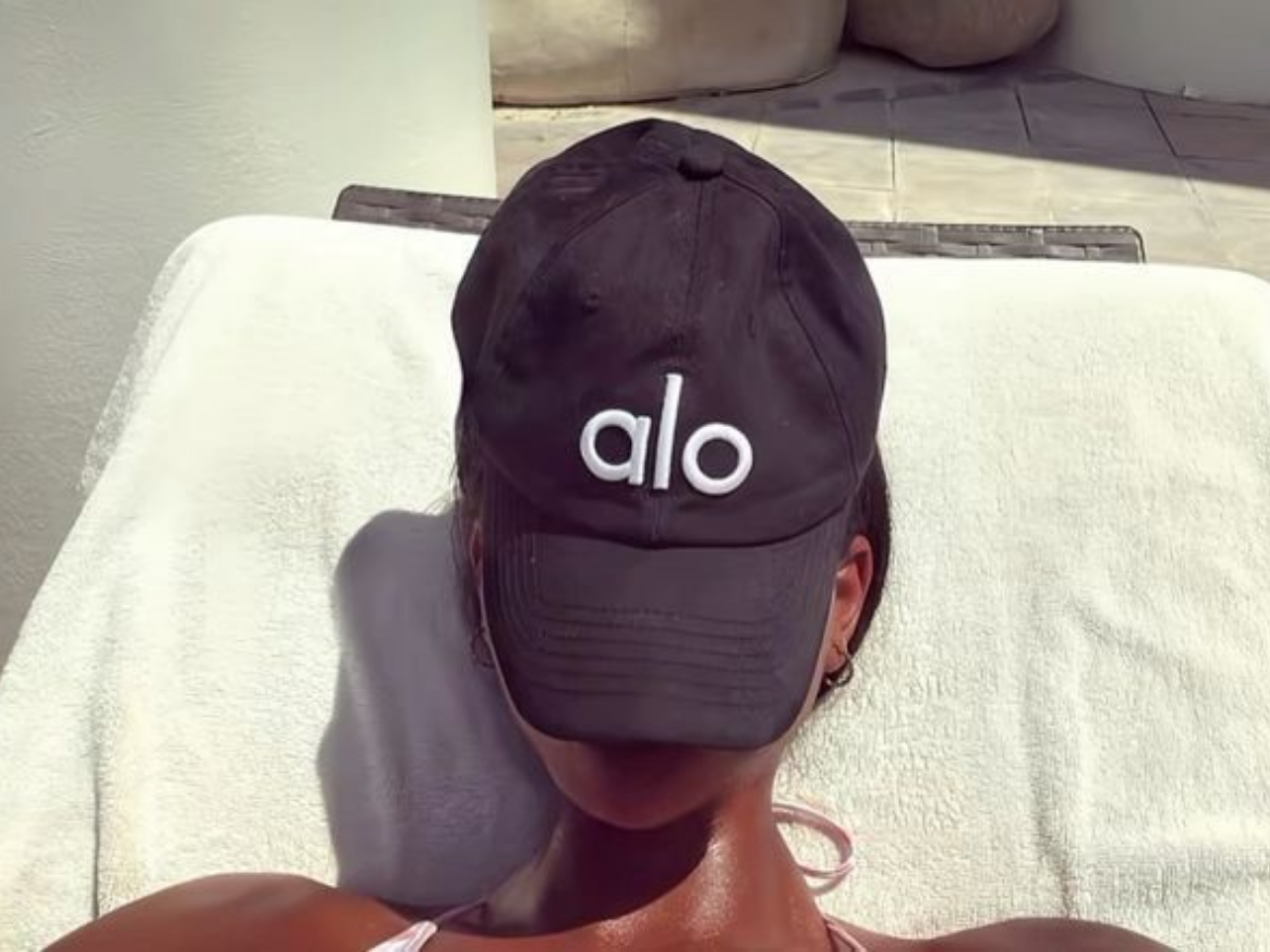
There is a very specific outfit that has become almost a uniform for modern wellness. Matching leggings, a cropped top, an oversized hoodie or sweatshirt, slicked-back hair, a giant water bottle and, somewhere nearby, a Pilates studio. You may not have actually done Pilates that morning. You may have spent three hours at your desk. You may have gone to the supermarket, answered emails and had lunch with your friends. But somehow, if you are wearing an Alo set, you look like you could have just walked out of a wellness retreat where everyone drinks green juice and has excellent boundaries. And that is exactly why Alo Yoga is so interesting. Because when you buy the set, are you really buying leggings and a sports bra? Or are you buying the idea of the woman who wears them?
Alo has become much bigger than an activewear brand. Its name has become attached to a particular version of wellness: Pilates, yoga, clean eating, matcha, skincare, self-care, expensive smoothies, beautiful studios and the general idea that your life is organised, healthy and aesthetically pleasing. And this is where the brand becomes commercially fascinating. Because there are plenty of companies making leggings. There are plenty making sports bras. There are plenty making sweatshirts. The physical product is not exactly a revolutionary invention. What Alo has managed to sell is something much harder to manufacture: a lifestyle you can put on.
And honestly, that is pretty clever.
Because think about what happens when you buy an Alo set. Technically, you are buying activewear. But the reason you might want that particular set rather than another pair of leggings isn't necessarily because you need leggings. You probably already have leggings. Maybe several pairs. What you're buying is the feeling that comes with them. You put on the matching set and suddenly your outfit feels intentional. You look more put together. You can go from Pilates to coffee to errands without changing. You feel like the woman who has her morning routine figured out. The clothes aren't just serving the activity anymore. The activity has become part of the identity the clothes communicate.
And this is where the matching set becomes particularly powerful. A pair of black leggings is just a pair of black leggings. Add a matching top, perhaps an oversized zip-up and the right trainers, and suddenly it becomes an outfit. That distinction matters. Alo isn't only selling individual pieces; it is encouraging you to buy into a complete visual language. The matching colours, silhouettes and layers make the clothes feel like a system. And once you have the leggings, you can justify the matching jacket. Once you have the jacket, maybe you need the matching bra. Then a sweatshirt. Then a tennis skirt. Then a cap. Then a bag. Suddenly you didn't buy one outfit. You bought a wardrobe for a lifestyle you may or may not actually live.
That is the genius of lifestyle branding. The product creates a reason to buy the next product.
And Alo has understood that the modern consumer doesn't necessarily want to look like she is going to the gym. She wants to look like wellness is part of her life. There is a subtle but important difference. Traditional sportswear often focused on performance: does it support you? Does it breathe? Does it stretch? Does it survive a workout? Alo also talks about performance, but its visual identity extends far beyond the gym. The clothes are designed to exist in the spaces around the workout too. The coffee afterwards. The walk home. The airport. The supermarket. The casual lunch. The mirror selfie.
The workout is almost the excuse.
The lifestyle is the product.
This is why the rise of Pilates culture has been so commercially useful for brands like Alo. Pilates doesn't just occupy an hour of your day. It comes with an entire aesthetic. The studio. The socks. The water bottle. The tote bag. The neutral-toned outfit. The smoothie afterwards. The skincare. The candles. The wellness vocabulary. And suddenly, an exercise class becomes a consumer ecosystem. You don't just need something to wear while exercising. You need something that looks right before and after exercising.
And that is where Alo sits perfectly.
It has become part of what wellness looks like.
Which is slightly funny when you think about it.
Because wellness was originally supposed to be about feeling better. Moving your body. Sleeping. Eating well. Managing stress. Taking care of yourself. Now, somehow, wellness can also mean owning the correct leggings to demonstrate that you care about wellness.
And this is where we need to ask the JOPI question:
When did wellness become something we could shop for?
The answer is probably: a long time ago. But social media accelerated it dramatically. Instagram and TikTok transformed wellness from a private experience into something highly visible. Your morning routine became content. Your breakfast became content. Your workout became content. Your skincare became content. Even your water bottle became content.
And when something becomes visible, brands can sell products around it.
Suddenly, you don't just want to feel healthy.
You want to look healthy.
That distinction is enormous.
Because feeling healthy is internal. Looking healthy is visual. And visual things are incredibly easy to market.
Alo's campaigns fit perfectly into this world because they don't just show you clothes. They show you people living a particular kind of life. Beautiful locations. Beautiful bodies. Beautiful movement. Beautiful lighting. Beautiful friends. Beautiful mornings. Everything looks calm, controlled and slightly aspirational.
You aren't necessarily thinking, “I need these leggings because my current leggings don't perform well.”
You're thinking:
“I want to look like that.”
And that is a much stronger desire.
This is the same psychology we see everywhere in lifestyle consumption. We buy the cookbook because we want to become someone who cooks. We buy the planner because we want to become someone who is organised. We buy the expensive skincare because we want to become someone who takes care of herself. We buy the matcha because we want to become someone who has a wellness routine.
And we buy the Alo set because we want to become the woman who effortlessly walks into Pilates at 8 a.m.
The product becomes a little piece of the identity.
But here's the important part: there is nothing inherently wrong with that.
We all do this.
Clothing has always been a form of identity. You dress differently when you go to a job interview than when you go to the beach. You wear different things when you want to feel sexy, powerful, comfortable or elegant. Clothes affect how other people see us, but they also affect how we see ourselves.
There is actually research behind the idea that clothing can influence our psychological state and behaviour. We don't just put clothes on our bodies; we attach meanings to them. So if putting on an Alo set genuinely makes you feel motivated to go to Pilates, move your body or take better care of yourself, maybe that purchase isn't completely superficial.
The question is simply where the motivation ends and the consumption begins.
Because buying the outfit isn't the same as doing the workout.
And a matching set cannot give you a healthy lifestyle.
It can only make the healthy lifestyle look very convincing.
This is where wellness marketing can become slightly dangerous—not necessarily because the individual products are bad, but because the industry can make us feel as though self-improvement is something we need to continuously purchase. New leggings. New supplements. New skincare. New protein powder. New water bottle. New journal. New fitness class. New morning routine.
At some point, wellness starts looking suspiciously like shopping.
And Alo is an excellent example because its products are so easy to integrate into everyday life. You don't have to stop wearing them after the workout. You can wear them all day. Which means the brand stays visible for longer. Your outfit becomes a walking advertisement.
And when other women see you wearing it, the cycle continues.
She looks good.
She's wearing Alo.
Maybe I should get Alo.
Then someone sees you.
You look good.
You're wearing Alo.
Maybe she should get Alo.
And suddenly a pair of leggings has become a social signal.
This is the fascinating part about fashion and status. You don't always buy something because it is objectively better. Sometimes you buy it because other people understand what it represents.
Alo is increasingly recognisable within a particular cultural group: women interested in fitness, wellness, fashion and lifestyle content. Wearing it can signal that you participate in that world.
It says:
I work out.
I care about wellness.
I know the brands.
I understand the aesthetic.
I am part of this lifestyle.
And again, there is nothing wrong with that.
But you should know that you're doing it.
Because the more aware you are of what your clothes are communicating, the more control you have over your wardrobe.
And this is where I think Alo gets something very right: it made activewear socially acceptable outside of exercise.
There was a time when wearing leggings to brunch could look like you had simply forgotten to change after the gym. Now, a carefully styled activewear outfit can be completely intentional. The line between sportswear and everyday fashion has become almost irrelevant.
Alo sits directly in that space.
It is athletic enough to make sense in a studio but fashionable enough to make sense in a café.
And that is commercially brilliant because it dramatically increases how often you can wear the product.
If a dress only works for dinners, you might wear it ten times.
If your leggings work for Pilates, coffee, errands, travel and lounging at home, suddenly you can justify spending more on them.
Cost per wear becomes the argument.
And honestly, that can be a very reasonable argument.
If you buy something expensive and wear it constantly, it may make more sense than buying five cheaper things you barely wear.
But we need to be careful not to use cost-per-wear as an excuse to buy things we don't need.
A €150 pair of leggings worn 100 times is €1.50 per wear.
A €150 pair of leggings worn twice is €75 per wear.
The mathematics changes very quickly.
So perhaps the smarter question isn't:
“Is Alo worth the money?”
It's:
“Will I actually wear this enough for it to be worth the money to me?”
That's a much more useful question.
Because the best activewear isn't necessarily the brand with the most recognisable logo. It's the one you actually reach for.
And this is where JOPI has to separate the product from the fantasy.
Maybe Alo's fabric feels incredible on you.
Maybe the fit is perfect.
Maybe you love the colours.
Maybe the leggings actually stay up during your workout.
Maybe the pieces last.
Then great. There is a genuine product reason to buy them.
But if you are buying the set because the campaign made you imagine that you will suddenly become the woman who wakes up at 6 a.m., drinks green juice and never cancels Pilates, that's something else.
You are not buying leggings.
You're buying future-you.
And future-you is one of the easiest people in the world to sell to.
Because she has perfect habits.
She never procrastinates.
She exercises.
She drinks enough water.
She eats vegetables.
She has clear skin.
She answers emails on time.
She meditates.
She somehow has eight hours of sleep every night.
And she definitely owns matching activewear.
The problem is that after you buy the clothes, you still have to become her.
And no brand can do that part for you.
That is perhaps the most important thing to remember about wellness culture. Products can support habits, but they cannot replace them.
A beautiful Pilates set won't make you exercise.
An expensive water bottle won't make you drink more water.
A wellness retreat won't automatically make you less stressed.
A matcha won't make you healthier.
And a skincare shelf won't give you perfect skin.
At some point, you still have to do the boring part.
You have to actually live the lifestyle.
And maybe that is why Alo works so well as a brand. It makes the boring part look beautiful.
And honestly, I understand the appeal.
There is something motivating about putting on an outfit you feel good in and going to work out. There is something fun about having a matching set. There is something satisfying about looking polished even when you're dressed casually. And there is absolutely nothing wrong with enjoying the aesthetics of wellness.
The problem begins when the aesthetic becomes more important than the wellness.
When you spend an hour choosing the perfect Pilates outfit and then spend twenty minutes actually exercising.
When your morning routine becomes more about filming it than experiencing it.
When “self-care” starts meaning buying something every time you feel stressed.
When wellness becomes another form of perfectionism.
That is when we need to step back.
Because you do not need to look like a wellness girl to take care of yourself.
You can exercise in an old T-shirt.
You can drink your coffee instead of matcha.
You can skip Pilates.
You can go for a walk.
You can eat the pasta.
You can have a lazy Sunday.
You can own one pair of leggings and wear them until they fall apart.
Wellness doesn't have a dress code.
The algorithm does.
And I think that distinction is worth remembering.
So, are you buying activewear or the wellness lifestyle?
Probably both.
And that's okay.
The activewear is real. The fabric is real. The design is real. The comfort is real. The brand has built a recognisable aesthetic around movement, wellness and modern lifestyle. But the lifestyle you're buying into is partly a story—a very carefully constructed story about the kind of woman you could be.
The clever part is that you don't have to completely believe the story for it to work.
You just have to like the feeling.
And maybe that's what fashion has always been about. We put on clothes and become slightly different versions of ourselves. Sometimes that is superficial. Sometimes it is motivating. Sometimes it is both.
So if your Alo set makes you feel good, wear it.
Go to Pilates.
Go get the matcha.
Take the cute mirror selfie.
Live your best wellness-girl life.
Just don't confuse the uniform with the lifestyle.
Because the most expensive thing about wellness isn't the leggings.
It's believing you need to buy something new every time you want to become a better version of yourself.
And honestly, we can keep the cute set.
Just remember to actually do the workout.
But why?